

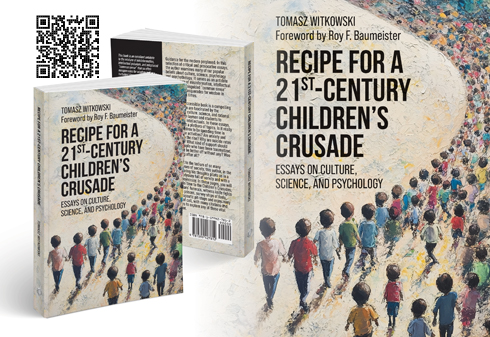
Z okazji ukazania się Recipe for a 21st-Century Children’s Crusade. Essays on Culture, Science, and Psychology flagowy magazyn Brytyjskiego Towarzystwa Psychologicznego – The Psychologist, opublikował fragment książki. Zapraszam serdecznie do lektury!
Repairing the child in a therapeutic pit stop
―Khaled Hosseini
Sometime before the pandemic, a journalist asked me: „How much time should children spend in extracurricular activities?” Whilst I know it is impolite to answer a question with another question, here I made an exception to the rule in an attempt to discover any hidden meanings in her question. „And how many hours a day do you think slaves should work?” I retorted. In the thoughtless request for advice on the amount of time children should spend in extracurricular activities, there is the assumption that they are actually necessary, and that such activities serve children and contribute to their well-being, that they are better than the company of parents, grandparents and the playground, that they will help them get a better position in the future, and so on. However, both this well-being and the position in the future are measured by a set of values which we have accepted, and no objective measure can be applied to them. Perhaps in a few decades’ time someone will find this question just as absurd as a discussion of the number of hours a slave should work, given the fact that one human is enslaved by another. But no one noticed this absurdity until a few hundred years ago. Perhaps they were seeking a rational answer to such a question, based on science and experience, and which was economically justified, just as today we are looking for an answer to the question of how much we can permissibly burden our children with.
The luxury of a shared meal
Intensifying childhood is a relatively new trend in our cultural landscape. This shift may have been documented for the first time, at least in the U.S., by a nationwide survey of time diaries conducted by the University of Michigan’s Survey Research Center between 1981 and 1997. Over the 16 years covered by the study, children lost 12 hours a week of their free time. Of these, they spent three hours less on play and six hours less on spontaneous outdoor activities. During the same period, the time spent on organized sports activities doubled, and so-called passive entertainment (watching siblings and other people playing or doing something) increased six-fold, from half an hour a week to over three hours. The time spent on homework also increased by 50 percent. By contrast, conversations between parents and children, during which nothing else is done, almost completely disappeared from the timetable of family life. [i]
In another nationwide study conducted in the U.S., it turned out that the number of families who declare that they regularly eat dinner together has decreased by one-third. [ii] Perhaps this wouldn’t be so alarming, were it not for the fact that there is a strong connection between regular family meals and many other positive aspects of life, such as: academic success, psychological adjustment, lower rates of alcohol and drug use, avoidance of premature sexual behavior and fewer suicide attempts. A lack of regular family meals was associated with a higher risk of failure in all these areas. More time spent eating together at home was found to be the strongest predictor of more positive outcomes and fewer behavioral problems. This factor had a much stronger impact than time spent in school, studying, going to church, playing sports, or artistic activities. The results were similar for all types of families, and regardless of income level. [iii]
Parenting as a product development project
The world of market values and hypercompetitive adults seems to have invaded the family. Parents love their children as much as previous generations, but bring them up in a culture that defines a good parent as a provider of opportunities in our competitive world. Parenting has become a „product development project,” and insecure parents never know if they’ve done enough to achieve this end. Allocating and organizing time and providing external stimulation makes parents aware that their children are in the game, and they can get on with their own work.
This trend, outlined briefly above, was not a historical peculiarity of American culture in the late 20th century. It was initiated, gained momentum and still continues to grow in most Western societies, although it may not be studied as intensively as in the U.S.. In a survey conducted in 2017 by Mental Health America, adolescents aged 11 to 17 were asked about their sources of greatest stress. 61 percent replied that it was juggling their priorities (school, sport, work, activity in various types of clubs, etc.). [iv] Another survey in the same year found that 78 percent of children aged nine to 13 complained about a lack of free time. [v]
The period of the pandemic was a kind of intermission in this race. Some families used the excess free time to tighten and strengthen mutual relations, whilst in others, as a result of the loss of routine patterns of everyday activities, a kind of anomie occurred as existing goals and values were called into question. There were also families in which, as a result of isolation, violent tendencies took on unprecedented proportions.
Increasing demands on children has an impact on their mental well-being. Overburdened, they are increasingly less able to cope with the pace of life imposed on them, and the alarming growth in the number of diagnosed mental disorders, self-harm and suicide attempts indicates that by escalating our expectations of them, we have probably already hit the ceiling. [vi]
Therapeutic pit stops
However, what would our self-satisfied civilization be if it did not propose an essentially absurd solution? After all, just like a Formula 1 car, a person operating in hypercompetitive conditions needs a pit stop to make any necessary repairs. So what could be simpler than to just pop into the therapist’s consulting room for an hour or so when facing the next lap? Maybe to the psychiatrist for some psychotropic drugs? Or maybe to a personal coach who will make the correct tuning?
We offer therapeutic pit stops both for those children deprived of shared family meals, conversations with parents, and running from one extracurricular activity to another, as well as for those experiencing violence at home or in the environment in which they are living. The chorus of voices calling for the employment of legions of psychologists and therapists in schools and for increasing spending on child psychiatry shows no sign of abating. Children who do not do well in the race which they have been forced to enter are taken to the therapist’s consulting room, where they are to be restored to fitness for further participation in the race. A very dangerous assumption is hidden in this approach, and that is that the problem lies in the psyche of the young patient. In all this madness, rarely does a sober voice suggest that it would be better to fix what is causing the problems — the environment.
Moreover, such a voice rarely breaks through the marketing jargon of the therapeutic culture in which we have been living for at least several decades. The dogma assumes that repairing alleged defects of the psyche should be dealt with by professionals, and this fits perfectly with the expectations of the many interested parties. Mental health providers inherently do not see the benefit in offering cheap and sustainable solutions to problems. If, instead of a diagnosis of ADHD and a prescription for Ritalin, they improved the environment in which the child lives, both they and pharmaceutical companies would lose a client who promises at least a dozen or so years of dependence on their products and services. Similarly, therapists extending a helping hand are more interested in the time that patients spend in their consulting rooms, analyzing, for example, their childhood problems as well as their emotions, than the time that is devoted to shared meals in their family home.
If problems affect the child, entrusting them to the care of professionals is also often convenient for parents. Firstly, they gain a false conviction that their offspring will be taken care of by people competent and experienced in dealing with similar cases, and secondly, such a solution does not interfere with involvement in their own race. They do not have to change their customs and habits. Only one minor additional requirement appears in their lives, and that is to deliver their small patient to a certain address from time to time. The children themselves have the least to say, in accordance with the old saying that „children should be seen but not heard.”

Szerzej o tym, jak ideologia wypiera naukę, debatę i zdrowy rozsądek, piszę w zbiorze esejów „Zawracanie statków głupców i inne eseje”. Książka w księgarni Bonito »
Chcesz dostawać moje nowe teksty e-mailem? Zapisz się poniżej.

