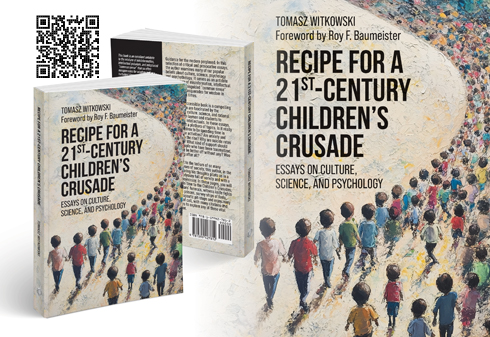
Fragment mojej najnowszej ksiażki w „The Skeptic”

The Werther effect: a recipe for a 21st-century Children’s Crusade

This piece contains in-depth discussion of the prevalence of suicide among young people.

In May 1212, 12-year-old Stephen of Cloyes announced to the world that Jesus Christ had authorised him to organise a crusade to the Holy Land. He drew crowds of children with him, all traveling south. Most of them were boys from peasant families, but there were also some sons of the nobility. Some had run away from home, others had left with the family’s blessing. A group of girls and a number of young priests and adult pilgrims also joined them.

Stephen persuaded at least 3,000 children to take part in the crusade, although some sources say it may have been as many as half a million. Many of them died on the way due to hunger and the extreme heat. When they reached Marseilles, the sea did not part as Stephen had prophesied, and so some of the discouraged participants returned home. As for those who remained, a cunning merchant offered to transport them to the Holy Land in his seven ships. Two of them sank, and the passengers of the other five were sold into slavery to the Saracens.

When news of Stephen’s crusade reached Germany, shortly after it set out, Nicholas of Cologne gathered an army of local children ready to go south. This was a significantly smaller group, numbering “only” 12,000. When they reached the shore, the sea refused to part for them too. They decided to wander on until they reached the place where the miracle was prophesied to take place. A few returned, but the others were never heard of again.

Epidemic of suicides

The history of the Children’s Crusades is invaluable as the pretext for a thought experiment which can provide us with a better insight into the present. After all, as the universal but irrefutable wisdom has it, those who do not learn from history are doomed to repeat it. So, let us consider a few questions: why did children go on crusades in the 13th century? Why were there no such crusades either earlier or later in our history? Why did those crusades start from France and Germany, and not from, say, Poland or Scandinavia? Why aren’t they happening today? And the most important question: what social elements in play at the beginning of the 13th century should be eliminated to prevent such tragic crusades?

More than 800 years after the Children’s Crusades, we are experiencing what we have generally come to call an epidemic of suicide among children and adolescents. Three decades ago, the gravest public health threats to teenagers in the United States came from binge drinking, drunk driving, teenage pregnancy and smoking. These have since fallen sharply, replaced by a new public health concern: soaring rates of mental health disorders and suicide attempts. For people aged 10 to 24, suicide rates, stable from 2000 to 2007, leaped 57.4% from 6.8 per 100,000 in 2007 to 10.7 in 2018. Between 2007–2009 and 2016–2018, suicide rates increased significantly in 42 states. In the 10 years leading up to the Covid pandemic, suicidal thoughts and behaviours increased by about 40% among young people, according to the Centers for Disease Control and Prevention. A study published in 2023 found that 22% of teenagers had considered attempting suicide in the past year, of which female students accounted for more than twice the attempts by male students.

This epidemic of suicide is not just an American problem. In Europe, suicide is the second most common cause of death among adolescents aged 15 to 19. Tragically, almost 1,200 children and adolescents aged 10 to 19 end their own lives every year, which is an estimated three lives per day lost to suicide in Europe.

A record number of suicide attempts by children and adolescents was noted in Poland in 2022. The number of suicide attempts in this country has been growing significantly since 2013 (except for 2020). However, the recent increase is shocking. While in 2020 there were 843 suicide attempts made by children, in 2021 this figure was as high as 1,496. It is interesting to note that the number of suicide attempts ending in death has been decreasing at the same time. Just for an example, in 2013, 148 children killed themselves, while in 2020 the figure was 107. An increase was again recorded in 2021, when the figure rose to 127.

Disturbingly, the number of suicide attempts in 2020 by children aged seven to 12 was 29, but in 2021 this figure had increased to 51. Currently, about 6% of deaths among children and adolescents under the age of 18 are suicides. Fortunately, in the zero to six age group, there have been no recorded suicide attempts resulting in death since 2013, although psychologists report that recently children aged as young as six have begun to report suicidal thoughts.

It is difficult to obtain reliable historical data which could be used for comparison, but the few studies that appeared at the turn of the nineteenth and twentieth centuries and later, before World War II, show that these numbers were significantly lower, at least in Europe. However, it is worth noting that the phenomenon of suicide among children and adolescents, although not as intense as it is currently, has always been an element of social reality. The increase in these depressing indicators is accompanied by an increasing number of studies whose authors are looking for possible reasons for this state of affairs, as well as ways to counteract these unfavourable trends.


Chcesz dostawać moje nowe teksty e-mailem? Zapisz się poniżej.

Fragment mojej najnowszej ksiażki w „The Psychologist”


Repairing the child in a therapeutic pit stop

Children aren’t coloring books. You don’t get to fill them with your favorite colors.

―Khaled Hosseini

Sometime before the pandemic, a journalist asked me: „How much time should children spend in extracurricular activities?” Whilst I know it is impolite to answer a question with another question, here I made an exception to the rule in an attempt to discover any hidden meanings in her question. „And how many hours a day do you think slaves should work?” I retorted. In the thoughtless request for advice on the amount of time children should spend in extracurricular activities, there is the assumption that they are actually necessary, and that such activities serve children and contribute to their well-being, that they are better than the company of parents, grandparents and the playground, that they will help them get a better position in the future, and so on. However, both this well-being and the position in the future are measured by a set of values which we have accepted, and no objective measure can be applied to them. Perhaps in a few decades’ time someone will find this question just as absurd as a discussion of the number of hours a slave should work, given the fact that one human is enslaved by another. But no one noticed this absurdity until a few hundred years ago. Perhaps they were seeking a rational answer to such a question, based on science and experience, and which was economically justified, just as today we are looking for an answer to the question of how much we can permissibly burden our children with.


The luxury of a shared meal

Intensifying childhood is a relatively new trend in our cultural landscape. This shift may have been documented for the first time, at least in the U.S., by a nationwide survey of time diaries conducted by the University of Michigan’s Survey Research Center between 1981 and 1997. Over the 16 years covered by the study, children lost 12 hours a week of their free time. Of these, they spent three hours less on play and six hours less on spontaneous outdoor activities. During the same period, the time spent on organized sports activities doubled, and so-called passive entertainment (watching siblings and other people playing or doing something) increased six-fold, from half an hour a week to over three hours. The time spent on homework also increased by 50 percent. By contrast, conversations between parents and children, during which nothing else is done, almost completely disappeared from the timetable of family life. [i]

In another nationwide study conducted in the U.S., it turned out that the number of families who declare that they regularly eat dinner together has decreased by one-third. [ii] Perhaps this wouldn’t be so alarming, were it not for the fact that there is a strong connection between regular family meals and many other positive aspects of life, such as: academic success, psychological adjustment, lower rates of alcohol and drug use, avoidance of premature sexual behavior and fewer suicide attempts. A lack of regular family meals was associated with a higher risk of failure in all these areas. More time spent eating together at home was found to be the strongest predictor of more positive outcomes and fewer behavioral problems. This factor had a much stronger impact than time spent in school, studying, going to church, playing sports, or artistic activities. The results were similar for all types of families, and regardless of income level. [iii]


Parenting as a product development project

The world of market values and hypercompetitive adults seems to have invaded the family. Parents love their children as much as previous generations, but bring them up in a culture that defines a good parent as a provider of opportunities in our competitive world. Parenting has become a „product development project,” and insecure parents never know if they’ve done enough to achieve this end. Allocating and organizing time and providing external stimulation makes parents aware that their children are in the game, and they can get on with their own work.

This trend, outlined briefly above, was not a historical peculiarity of American culture in the late 20th century. It was initiated, gained momentum and still continues to grow in most Western societies, although it may not be studied as intensively as in the U.S.. In a survey conducted in 2017 by Mental Health America, adolescents aged 11 to 17 were asked about their sources of greatest stress. 61 percent replied that it was juggling their priorities (school, sport, work, activity in various types of clubs, etc.). [iv] Another survey in the same year found that 78 percent of children aged nine to 13 complained about a lack of free time. [v]

The period of the pandemic was a kind of intermission in this race. Some families used the excess free time to tighten and strengthen mutual relations, whilst in others, as a result of the loss of routine patterns of everyday activities, a kind of anomie occurred as existing goals and values were called into question. There were also families in which, as a result of isolation, violent tendencies took on unprecedented proportions.

Increasing demands on children has an impact on their mental well-being. Overburdened, they are increasingly less able to cope with the pace of life imposed on them, and the alarming growth in the number of diagnosed mental disorders, self-harm and suicide attempts indicates that by escalating our expectations of them, we have probably already hit the ceiling. [vi]


Therapeutic pit stops

However, what would our self-satisfied civilization be if it did not propose an essentially absurd solution? After all, just like a Formula 1 car, a person operating in hypercompetitive conditions needs a pit stop to make any necessary repairs. So what could be simpler than to just pop into the therapist’s consulting room for an hour or so when facing the next lap? Maybe to the psychiatrist for some psychotropic drugs? Or maybe to a personal coach who will make the correct tuning?

We offer therapeutic pit stops both for those children deprived of shared family meals, conversations with parents, and running from one extracurricular activity to another, as well as for those experiencing violence at home or in the environment in which they are living. The chorus of voices calling for the employment of legions of psychologists and therapists in schools and for increasing spending on child psychiatry shows no sign of abating. Children who do not do well in the race which they have been forced to enter are taken to the therapist’s consulting room, where they are to be restored to fitness for further participation in the race. A very dangerous assumption is hidden in this approach, and that is that the problem lies in the psyche of the young patient. In all this madness, rarely does a sober voice suggest that it would be better to fix what is causing the problems — the environment.

Moreover, such a voice rarely breaks through the marketing jargon of the therapeutic culture in which we have been living for at least several decades. The dogma assumes that repairing alleged defects of the psyche should be dealt with by professionals, and this fits perfectly with the expectations of the many interested parties. Mental health providers inherently do not see the benefit in offering cheap and sustainable solutions to problems. If, instead of a diagnosis of ADHD and a prescription for Ritalin, they improved the environment in which the child lives, both they and pharmaceutical companies would lose a client who promises at least a dozen or so years of dependence on their products and services. Similarly, therapists extending a helping hand are more interested in the time that patients spend in their consulting rooms, analyzing, for example, their childhood problems as well as their emotions, than the time that is devoted to shared meals in their family home.

If problems affect the child, entrusting them to the care of professionals is also often convenient for parents. Firstly, they gain a false conviction that their offspring will be taken care of by people competent and experienced in dealing with similar cases, and secondly, such a solution does not interfere with involvement in their own race. They do not have to change their customs and habits. Only one minor additional requirement appears in their lives, and that is to deliver their small patient to a certain address from time to time. The children themselves have the least to say, in accordance with the old saying that „children should be seen but not heard.”


Zawracanie statków głupców i inne eseje – okładka

Szerzej o tym, jak ideologia wypiera naukę, debatę i zdrowy rozsądek, piszę w zbiorze esejów „Zawracanie statków głupców i inne eseje”. Książka w księgarni Bonito »

Chcesz dostawać moje nowe teksty e-mailem? Zapisz się poniżej.

If we don’t solve the incentives problem, we will become a very narrow discipline

Pod tym tytułem ukazał się fragment mojej nowej książki Shaping Psychology: Perspectives on Legacy, Controversy and the Future of the Field opublikowany przez flagowe czasopismo British Psychological Society: Tekst zawiera fragmenty mojej rozmowy z Brianem Nosekiem, znanym propagatorem ruchu Otwartej…

Pod tym tytułem ukazał się fragment mojej nowej książki Shaping Psychology: Perspectives on Legacy, Controversy and the Future of the Field opublikowany przez flagowe czasopismo British Psychological Society: Tekst zawiera fragmenty mojej rozmowy z Brianem Nosekiem, znanym propagatorem ruchu Otwartej Nauki i autorem wielu naukowych inicjatyw, o których już wielokrotnie pisałem na łamach tego bloga i nie tylko.

‚If we don’t solve the incentives problem, we will become a very narrow discipline’

Tomasz Witkowski meets Brian Nosek, in an edited extract from Tomasz’s new book of interviews.
This is an edited extract from ‘Chapter 13, Brian A. Nosek: Open Science and Reproducibility Projects’ in Shaping Psychology: Perspectives on Legacy, Controversy and the Future of the Field by Tomasz Witkowski (Palgrave MacMillan, 2020).
Prof. Nosek, you’re one of the world’s most well-known advocates of the open science movement, engaged in improving transparency in science. What led you to go beyond your research on implicit cognition and engage to such a significant degree in improving research methods and collaboration between scientists? My interest in these issues started in graduate school, when I took Alan Kazdin’s research methods course. This was around 1997, and he had us reading papers from the 1960s and 1970s by Bob Rosenthal, Tony Greenwald, Jacob Cohen and Paul Meehl, where they articulate challenges like publication bias, lack of replication or low power, and they outlined solutions. For example, let’s try and do more replications, let’s increase the power of studies. Even preregistration was mentioned in some of these articles. It was shocking as a grad student in the late 90s to think that methodology has been outlining these problems and solutions for 30 years, but nothing has changed. Why is that? So, like many graduate student cohorts, we would have discussions after lectures or meetings at the bar and talked about how we would change the system if we could. And, of course, we didn’t have the opportunity to make any substantial changes at the time, but the interest in these issues remained at the core of how I thought about the research we did in our laboratory. So we started with trying to address the power of our designs. We created a website for collecting data about implicit biases, which became very popular. We achieved very high power tests of the kinds of questions we were investigating. When I became a faculty member, we made it a routine practice to share as much of our materials and data as we could on our personal websites. And when services came up, we tried to adopt things that would improve our sharing. In the mid-2000s I started to write grants to the National Institutes of Health and National Science Foundation to create what we called at that time an open source science framework. We had a technical lab for a long time, we operated this website for collecting data, and we thought it would be useful to have a service that would make it easier to share that data and for others to use it as well. But we couldn’t get it funded then because there was just a wide range of reviews. Some said this was very important, a necessary change, and others said that people don’t like sharing data. It just wasn’t the right time. But there was a general interest that we had as a laboratory in improving the process of our own work, building tools for the technical portion of what we do, to make it easier for others to do it. Then, in 2011, a lot of these methodology issues became of broad interest to the research community because of the Diederik Stapel fraud and because of very surprising results being published in leading journals, like Daryl Bem’s ESP work. And then apaper in Psychological Science, “False-Positive Psychology” (Simmons et al. 2011), really crystallized for many people how we have some practices whose implications for the reliability of our results we don’t really understand. They provided a rhetorical tour de force of how that happened, which helped people to understand those behaviors and their consequences. So all of that is happening around the same time. One of our failures is with replication. Initial studies became public, and people failed to replicate them. As a laboratory, we had been thinking and talking about a lot of these issues for a long time, but we didn’t have anything concrete, no database of evidence of replicability of findings. We had individual studies that we failed to replicate, but that happens all the time, and you can’t really tell if there’s anything systematic. We decided to think about how to start a collaborative project, to see if we could replicate some meaningful sample studies in the field. So we have this replication project that turned into the Reproducibility Project: Psychology. Lots of people got interested very quickly, and that became a big project. Here’s the background on starting the Center for Open Science: Jeff Spies was a grad student in the laboratory with a history as a software developer, and we were looking for ideas for his dissertation. We kept coming back to this old project idea of an open source science framework. And while it was unusual, he decided it was very much in line with his long-standing interests, so he started working on that as a dissertation project. So we had this replication project and this technical project that received some broad attention, which we conceived of as lab projects. We were self-funded, without grants or anything, but then they came to the public’s attention, and some funders started calling. Very rapidly we moved from interesting but small projects to thinking about doing things in a big way. Within a matter of two months we went from a small lab to launching the COS as a non-profit. Why is it that only in the middle of the second decade of the twenty-first century have we openly started discussing the crisis in psychology, and in such a way that outside observers could conclude that its discovery came as a great surprise to scholars? That is a great question and I would love a good historical analysis to determine which of many possible reasons is the right one. In one sense, we’ve known about so many of these issues for a long time. The kindling for the reform movement has been there, and it has been accumulating for many years, so it had to happen sometime. Let’s say 2011 is the starting point. It could be an accident of history that this was the year it finally started. Another possibility is that all that was accumulating, and some stimulating, singular events occurred that made it a lot easier to confront this at the scale we’re doing now. The Stapel case, the Bem’s paper, the Simmons, Nelson, Simonsohn “False-Positive Psychology” paper. These individual cases captured a great deal of attention beyond just people who care about methodology, and this conversation has been ongoing since the 1960s. Those provided some stimulus to really ask “what are we going to do about this?” or “what is this, really?” The fact that they happened close together in time also may be a factor. Instead of just one event, they all started to pile on, and it’s like a dam broke. Another factor is that this issue is salient not only in psychology. It has been accumulating attention across other fields. Maybe, with the internet and social media, rather than just the thought that in my little field we have this problem, it is a lot easier to see outside our disciplinary silos and say, “my goodness, biomedicine, they’re having this problem too. Oh, economists, they’re having this problem. Hang on a second. Who isn’t having this problem?” Connecting those communities of people who care about these issues across disciplines may have facilitated collective action that made it a lot easier for the movement to become better, faster, and more impactful. I suspect that it’s a complicated mix of many causes, but it’s fascinating that even though those things have been known for a long time, these events congealed into a real movement this time. Despite all the problems we are talking about, some scientists are full of optimism. Are you yourself one of those optimists who believe we are at the threshold of a better tomorrow in our field? Yes. I am optimistic. And the reason I am is that a sustainable culture change is growing. But this doesn’t mean it’s happening fast. There are a lot of people in this movement that are very discouraged. They think, “we’ve worked this out already, why are people still doing it wrong? Let’s just get it done.” But culture change is hard; changing people’s behavior is hard. We have great literature that shows how hard it is to make these changes. Let’s pay attention to the parts of our literature that we can trust and apply it as effectively as we can to the movement as it is occurring. There is good reason to be optimistic, because the core challenges are becoming very well known as problems, and it’s hard to be in our field and not be aware of these challenges. That’s a big first step. Whether people will change their behavior or not remains to be seen. The second reason for optimism is that training is changing. Methodologists care about these things fundamentally and many are changing and updating statistics and methods courses. That matters, because training will stick with the generations as they come through this gradually. The third reason for optimism is that the stakeholders, founders, publishers, societies, and institutions are paying attention. Maybe not quickly, but they’re all changing their policies, their norms, and their incentives. Policy change is the best way to have sustainable change in the long term. The general shift from not requiring any transparency to encouraging or requiring openness fundamentally changes what comes through a journal. Incentives for preregistration and badges that make visible that other people are doing these behaviors, can have long-term accumulated consequences of forming new norms. Finally, Registered Reports are now offered by more than 200 journals. Registered Reports eliminates publication bias by conducting review and committing to publish results before the outcomes are observed. That is a fundamental change to the publication workflow and will have a lasting impact if it achieves broad adoption. All of the critiques of the movement saying that it’s not changing very fast are correct, but I don’t know if it can change faster than it is. The groundwork is being laid. The changes we’ve seen are not superficial. It’s not just one researcher and one team did something, and tried to replicate some findings, and that’s the end of it. Changes are happening in the structure of how we do our work, and that’s really what will help sustain it the long term. The seriousness of the crisis in psychology is often diminished by describing it as a replication crisis. We know, however, that it consists of many more problems than just the lack of replication. Which of them can be solved by the open science movement, and which should be overcome some other way? Replication is the low-hanging fruit of improving research practices – here is a finding, here is a methodology, let’s try to see how reliable that methodology is. From this point of view, the replication part of the movement helps stimulate attention to the broader issues of how we can make research progress as quickly as possible. Replication doesn’t solve problems like construct validity, attentiveness to how our theories get refined and formalized so that they are testable, or connecting our theories with our operationalizations and inferential tests. There are big challenges in how we reason, how we accumulate evidence, and how we combine that evidence into theories in science. Open science doesn’t solve these, but open science is an enabler of pursuing solutions to these challenges. We have a lot to mature in how we develop theories and how we make connections. But we can’t do that work without open evidence, without transparency on how we’re getting our claims, without better sharing, without materials being open and accessible, and without some replication to test our theoretical positions in a more formalized way. To me, the movement, at least in psychology, is finishing phase one, where the major theme was replication. I think it’s entering or midway into phase two, which is about generalizability. It’s not just about replicating a finding in that context, but about the breadth of where we can see that finding across different operationalization, across different samples, across different conditions of the experimental context. Next, I think, it’s going to be entering a phase focused on measurement and theory. Now we see what is reproducible on our base claims, how we can better connect this evidence to more theoretical claims? I see one more problem plaguing contemporary psychology, and which probably cannot be solved by the open science movement: the shift from direct observation of behavior, widely regarded as an advance in the development of scientific methodology, to introspection. This was demonstrated in an outstanding 2006 article by Baumeister et al., and recently confirmed by Doli´nski (2018), who replicated Baumeister’s investigations. Both articles show that over the last few decades, studies of behavior have become a rarity among psychologists. This issue is brought into sharper relief by the fact that the first of the two articles was published in the middle of the decade that the APA announced with great pomp as the decade of behavior. What are your thoughts on this issue? This is interesting, and I agree that it can’t be different than how we think about what the open science movement is trying to solve. We have to consider the incentives that shape individual researchers’ behaviors. If the focus of my attention in research is to publish as frequently as I can, in the most prestigious outlets that I can, then I have to make practical decisions about the kinds of questions that I investigate. Measuring real behavior, that’s hard. Sending out a survey, that’s easy. I can generate more publishable units doing that. Or using Mechanical Turk. Exactly. Researchers are already stressed about publication demands, and now open science movement is increasing the pressure for higher power. This makes it even harder to do those behavior studies – now, instead of 50 people you need 500. This is a real issue, elements of the open science movement – increasing power, increasing transparency, increasing rigor – could be at odds with the goal of getting the research community less focused on self-report surveys and more diverse in how it measures human behavior. If we don’t solve the incentives problem, then we will become a very narrow discipline. In part, that may reflect how hard is to study the things that we study. We have to recognize where we are as a discipline in terms of our tools and instrumentation, to be able to do some kinds of science. Then, we have to be realistic about what science can be done effectively with the available resources. In some ways, we have tried to study questions that we just don’t have the technology, the ability, or the power to study effectively. If we take seriously what questions can we productively investigate with the resources we have available, then we may recognize that a lot of the questions we want to study, cannot be studied effectively the way that we do science now. If those questions are really important, then we need to change how we do things. This is where another element of the open science movement has part of the solution–collaboration. Right now, we are rewarded for being a vertically integrated system. Myself or my small team comes up with an idea, designs a study, collects the data, writes the report, all on our own. This requires lots of resources devoted to small groups. If we move to more horizontal distribution, where many different people can contribute to a project we can study many questions that we are presently not able to study well. There might be one team designing the study, and 15 teams that contribute data. With that kind of model, if we get the reward system worked out we could study some questions more productively and with adequate power to actually make progress on the problem. The reform movement needs to attend to the effects of each change on the complex system of incentives and reports: What happens with increasing expectations for power? What will that change in what people study? How do we solve that? These systems are complex and getting all the incentives aligned for maximizing progress is hard. Czytaj dalej klikając TUTAJ
Więcej podobnych rozmów z najwybitniejszymi psychologami świata w mojej książce:

Moja rozmowa z dr. Konradem Bocianem na temat wyników Many Labs 2 w „Forum Akademickim”

Psychologia w kryzysie, choć popularna jak nigdy

Kryzys w psychologii – audycja w radiowej Dwójce

Czy połowa badań psychologicznych jest bezwartościowa?

Czy połowa wiedzy psychologicznej jest bezwartościowa?


Giganci psychologii – okładka

Rozmowy z wybitnymi psychologami naszych czasów o przeszłości i przyszłości ich dziedziny zebrałem w książce „Giganci psychologii. Rozmowy na miarę XXI wieku”. Książka w księgarni Bonito »

Chcesz dostawać moje nowe teksty e-mailem? Zapisz się poniżej.

O moich książkach w „The Psychologist”

Q&A – Tomasz Witkowski

Rebecca Stack, Associate Editor for Books, speaks to Tomasz Witkowski, the author of Psychology Led Astray: Cargo Cult in Science and Therapy.
Tell me a bit about yourself and how you came to write this book. I am a psychologist, who for has many years worked at two Polish universities and two in Germany. However, amassing points for publishing research on problems of little significance, conference ‘tourism’, and scrambling up the academic career ladder are not what I wanted to devote my life to. So I began to write books popularising psychology and to work with business. About 10 years ago I decided to write a modest book devoted to some of the myths prevalent in the teaching and understanding of psychology which I had notoriously come up against. This was partly for my own benefit, to categorise and brush up my own knowledge. It really was intended to be a modest little book, but during the course of writing the amount of material increased at an alarming rate as I uncovered more and more distortions and pseudoscience in what we usually call psychology. When the book had already reached over 400 pages, and I had used barely a third of the available material, I decided to publish it as Psychology Gone Wrong: The Dark Sides of Science and Therapy, the first volume of a trilogy. Psychology Led Astray is the second volume of this trilogy. Read more…

Zakazana psychologia, t. II – okładka

O tym, jak psychologia upodabnia się do nauki kultu cargo, piszę w drugim tomie „Zakazanej psychologii. Nauka kultu cargo i jej owoce”. Książka w księgarni Bonito »

Chcesz dostawać moje nowe teksty e-mailem? Zapisz się poniżej.