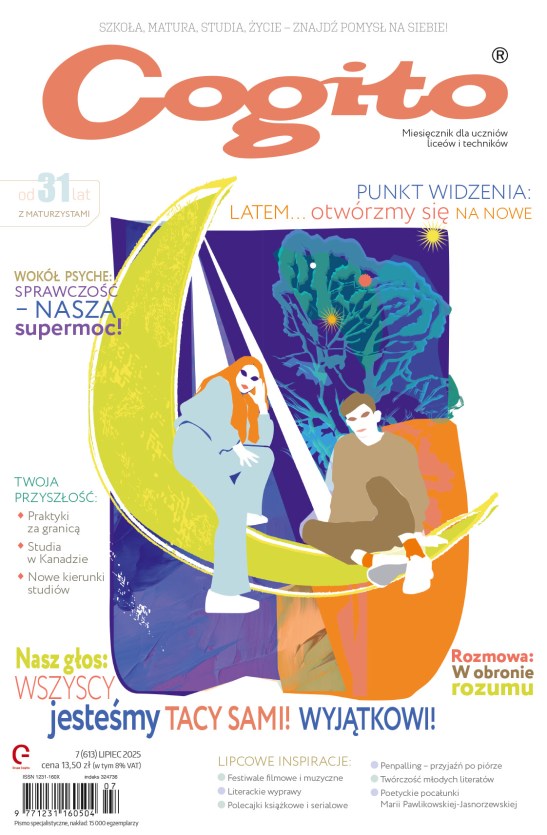
Zapraszam do lektury wywiadu, który dla miesięcznika Cogito przeprowadziła ze mną Emilia Kosiorek. Wywiad ukazał się w lipcowym numerze.
Cały wywiad przeczytasz w papierowym lub elektronicznym wydaniu miesięcznika klikając TUTAJ.
W języku angielskim wywiad jest dostępny w:

Not only is there fake news, but there can also be fake science

Disclaimer: Whenever the text refers to Forbidden Psychology, it denotes the original Polish series titled “Zakazana Psychologia”. The English-language books that address the same themes are “Psychology Gone Wrong: The Dark Sides of Science and Therapy” and “Psychology Led Astray: Cargo Cult in Science and Therapy”. However, these are not literal translations — the original Polish version consists of three volumes, while the English edition comprises two.
Flat Earthers, reptilians, chemtrails, and the allegedly still-living Elvis Presley are, for the majority of society (thankfully!), nothing more than laughable conspiracy theories. You don’t need a PhD to know that. But when we start talking about homeopathy, fortune-telling, neurolinguistic programming (NLP), Hellinger’s family constellations, bioenergy therapy, or astrology, it’s no longer as clear to everyone that these are nothing but pseudoscience. These more or less obviously nonsensical ideas share several common features: lack of repeatable research results (or lack of research at all), appeals to “secret knowledge,” “energy,” or “intuition,” resistance to criticism (every question is perceived as an attack), or conscious avoidance of scientific studies — “because the system doesn’t want you to know the truth.” Nevertheless, some of these theories and practices not only function successfully in society but have also entered the halls of academia, such as NLP, which is taught at the university level in Poland[1]. A clairvoyant can be summoned as a professional witness in a court case (yes, that’s an actual job!), and homeopathic substances are recommended by general practitioners and are available in pharmacies.
True science comes to the rescue of reason. It’s based on years of research verifying the truth of hypotheses, on the reputation of the institutions conducting the research, on the names of well-known scientists, and above all, it’s empirically confirmed. But is that always the case? In physics or chemistry, if a scientist makes a mistake in research, practical experience quickly reveals it, whether the error was intentional or not. However, in the broad domain of social sciences, including psychology, sociology, or economics, detecting errors, abuses, or fraud is neither fast nor obvious. What’s more, repeating the results and interpretations of such flawed studies can lead to very serious consequences. Imagine an ineffective therapy administered by a psychotherapist — at best, it simply doesn’t work, but at worst, it could lead to suicide.
It is precisely about pseudoscience and the sins of real science that we learn from the “Forbidden Psychology” series by Dr Tomasz Witkowski. The books in this series were published some time ago but have gained new life, and their content and message have the potential to reach a wider audience thanks to audiobook editions on Poland’s largest platforms.
However, the series isn’t just about psychology. It’s an attempt to expose and confront pseudoscience and the unreliability of scientists in various fields, though mainly within the social sciences. Readers who have so far admired the genius of Sigmund Freud or the brutal truth about human nature presented in Philip Zimbardo’s Stanford Prison Experiment may need to revise their views.
One particularly fascinating and shocking story is the brilliant hoax carried out by Dr Witkowski in the well-known Polish popular science magazine Charaktery[2]. Disguised as a non-existent French female scientist, he managed to publish an article about a therapy based on morphic resonance, which he had entirely made up. The very fact that this hoax succeeded, and the, let’s say, “casual” approach of Charaktery’s editorial board, is deeply concerning. Awareness that such a thing could happen in a magazine whose scientific board includes PhDs and professors raises serious questions about the reliability of scientists and forces us to ask: where should young researchers turn for trustworthy knowledge and role models?
All of the above prompted me to speak with Dr Witkowski. I hoped the conversation would restore my faith in science — a faith that had been somewhat shaken after reading Forbidden Psychology. Did it? Let’s find out.
Emilia Kosiorek: Our conversation is inspired by your series Forbidden Psychology, in which you describe how pseudoscience, as well as negligence and plain fraud, infiltrate science. Do you believe this problem concerns mainly psychology, or should we assume that people are people and fraudsters can appear in every field — medicine, physics? Are the social sciences more vulnerable to such behaviour?
Tomasz Witkowski: The degrees of scientific dishonesty certainly vary between disciplines, but in my view, it exists everywhere. Social sciences are indeed somewhat more susceptible because, broadly speaking, science can be divided into so-called “hot” and “cold” disciplines. The hot sciences have direct and immediate applications, such as market value or technological impact — fields like genetics, theoretical physics, etc. When results are published in those areas, they are quickly replicated and verified because a specific result directly leads to progress. In contrast, in disciplines like psychology, sociology, or even economics, verification doesn’t happen as rapidly, which is why various types of fraud can remain unnoticed for a long time.
EK: So, in the 21st century, is it still worth becoming a scientist, especially a scientist in the social sciences? Many young people choose to study psychology, social and behavioural sciences, and economics. Are they making the right choice?
TW: Absolutely. Science is one of the most fascinating endeavours a person can engage in. Perhaps art is just as intriguing. As for social sciences, last year Geoffrey Hinton, a cognitive psychologist, was awarded the Nobel Prize in Physics for his work on neural networks that led to the development of artificial intelligence. AI would never have emerged without input from psychologists, who have provided insight into how our minds and nervous systems function and how we process information. One could say that the social sciences have contributed significantly to what we’re experiencing today. The opportunities for work and discovery are tremendous, and I wholeheartedly believe it’s worth studying social sciences. Of course, one should engage in rigorous, mainstream science — and in psychology, preferably not the kind devoted to inventing next therapeutic modalities.
EK: Recently, the topic of mental health, particularly among young people, has become more visible in the media. We observe that more and more Poles report mental health issues, and more are also seeking help from psychologists and psychiatrists. How might the problems you discuss regarding professionalism in these professions, and the presence of pseudoscience within them, affect people’s actual health and lives?
TW: Undoubtedly, they can have a huge impact. If we’re dealing with therapies that are ineffective, unscientific, and unreliable — ones that produce weak or no results or even harmful effects — then we’re looking at a direct threat to health. Diagnostic practices also play a crucial role. Take this observation: when I was studying psychology, the most popular diagnostic category was neurosis. Today, nobody talks about neuroses anymore. Now it’s all about depression and ADHD. So, we must also acknowledge the trends and fashions that dominate diagnostic practices — they come and go.
EK: How do you assess the reception and impact of your work against pseudoscience in the academic world? Has anything changed over the years? Can we still find NLP courses and other pseudoscientific content in university curricula?
TW: Unfortunately, yes. Has anything changed…? When I started exposing pseudoscience in psychology, there was only one other person in Poland doing something similar, a guy who ran the blog “Fashionable Nonsense.” Now, there are many bloggers, YouTubers, and journalists popularising science and debunking pseudoscience. But as far as influence on academia goes… I wouldn’t overstate it. My influence has been minimal. That’s because academia operates by its own rules. It’s a world where your value is measured by how many publication points you earn, and hence the obsession with scoring those points. If you don’t interfere with that process — and I haven’t in any significant way — people like me are largely ignored, and the system continues, unfortunately.
EK: That’s not very encouraging; it does feel a bit like fighting windmills. But perhaps it’s still worth doing, for the sake of science or simply for intellectual integrity. How do we protect ourselves from pseudoscience? How do we respond when someone says they took an NLP course and it worked, or that they’ve always treated themselves with homeopathy? The argument about a lack of scientific evidence doesn’t seem to convince such people.
TW: Reaching such individuals is extremely difficult. But I can offer some advice to people who want to protect themselves from pseudoscience. First and foremost, we need to be aware that whenever we search for information — about therapies, treatments, or anything else — the algorithms that track our activity trap us in information bubbles. We must consciously look for information outside these bubbles, especially beyond social media, where the bubble is tightly sealed. If you’re a fan of homeopathy, your friends likely are too, and they share similar information. That’s a closed system. Secondly, if you’re reading a book about therapy, treatment, mental health, or science in general, the first thing to check is whether it has a bibliography, and how extensive it is. If a book lacks references, put it back on the shelf. That means everything in it came straight out of the author’s head and likely has no scientific basis.
EK: Speaking of scientific books — your books have recently become available as audiobooks, a format I personally love and through which I discovered your work. Meanwhile, on the same platform (BookBeat), Joseph Murphy’s The Power of Your Subconscious Mind is categorised under Non-Fiction and Health. Isn’t this kind of classification also a form of legitimising pseudoscience?
TW: Absolutely, it is. Back in the 1960s in the United States, if a publisher released a pseudoscientific book, scholars from respected universities would write protest letters asking for its withdrawal, or boycott the publisher altogether and refuse to publish their scientific work there. That tradition has long since disappeared. Sadly, even PWN (Polish Scientific Publishers) published a book on NLP. GWP (Gdańsk Psychological Publishing), which is known for its psychology titles, has released many works on Hellinger and NLP. These days, even the brand of a major scientific publisher like PWN is no longer a guarantee of quality, so that filter is gone too.
EK: But is every form of pseudoscience harmful? Shouldn’t people be free to believe in whatever they like?
TW: Yes, every pseudoscience is harmful. Let me share an example. In 2010, together with Professor Łukasz Turski, we sent a “Letter in Defence of Reason” to the Minister of Labour and Social Policy. It was a protest against adding professions like bioenergy therapist, astrologer, clairvoyant, and fortune-teller to the official national list of occupations. The letter was signed by nearly 5,000 people, most of them scientists. Why does this matter? One could argue that if someone wants to believe in astrology, it’s harmless — they’re just wasting time and money. But once such a job is officially recognised, its practitioners can be called as witnesses or expert consultants in court. We’ve already had a murder trial in Poland where a bioenergy therapist and a clairvoyant testified. A guilty verdict was issued based on their statements. Thankfully, the appellate court overturned the verdict and acquitted the man. But the original ruling was made without a body being found — one of the key pieces of evidence was that the energy therapist’s pendulum pointed to the suspect. This example shows just how far pseudoscience can go. What may seem trivial can end up determining people’s fates in court. Beyond that, pseudoscience is a violation of reason. If we continue to allow so many absurdities to circulate, people will lose, or have already lost, the ability to distinguish truth from falsehood.
EK: I must say that example is shocking. And describing pseudoscience as a violation of reason is quite apt. I once watched the film Behind the Curve about flat-earthers. Listening to their arguments felt exactly like my reason was being assaulted. It’s the same with anti-vaccine movements or advocates of pseudoscience and strange theories. Trying to reason with them leads only to responses like, “It’s a conspiracy — they want you to think that,” or “Just because we have no evidence doesn’t mean we’re wrong,” or “Your studies are part of a government-corporate plot.” And then comes the aggression, the assault. But let’s return to actual science. I’m currently conducting a sociology research project. In preparing it, I went through hundreds of academic studies and volumes of literature. I tried to rely on reputable sources — universities, research centres, expert opinions. Yet after reading Forbidden Psychology, I can’t be sure my sources are trustworthy if giants like Freud or Zimbardo have serious scientific sins. So, how do we find reliable sources? Where should young scientists look for authority?
TW: I wouldn’t turn away from scientific literature. The average reader or even average researcher doesn’t have the tools to determine whether fraud occurred in a given paper. Scientific publications undergo anonymous peer review — those reviews are usually written by field experts, and that’s still something to trust. Of course, we’ll never have 100% certainty that someone didn’t fabricate something. The case of Diederik Stapel, a Dutch psychologist, showed how someone could fabricate research data for years. He never conducted the studies, just made them up. A total of 58 of his papers were retracted. Currently, we’re facing the “paper mills” scandal in academia — groups of people professionally selling fake scientific articles that get published under scholars’ names, even though the scholars didn’t write them. These things happen all the time. And we don’t have many tools to catch them. Some of the most reliable tools are meta-analyses and systematic reviews, methods that compile large sets of research results on a specific topic and generalise the knowledge. For example, one meta-analysis on suicide and self-harm prevention effectiveness included 1,125 studies. Even if a few of those were fraudulent, they would get drowned in the mass of honest work, and the reliable data would still show the actual outcome. So, whenever you’re researching a topic, your first stop should be meta-analyses and systematic reviews. They are top-tier in the hierarchy of scientific evidence. Nothing above them is more reliable.
EK: Yes, in my own work, I used a meta-analysis for my literature review, and it proved a very valuable source of knowledge. But the key is having a large enough body of studies. Now I’m preparing for another research project. While looking for methodology guidelines, I came across advice from an educational organisation that said: “Choose a novel topic, conduct a study that no one has done before. After all, you want to contribute something new to science.” That immediately reminded me of the replication crisis you describe in Forbidden Psychology. Why are replication studies so rare? Is it just about funding — grants being seen as wasted if you repeat someone else’s work, or is there something more? After all, meta-analyses rely on replications.
TW: There are several reasons why replication studies are uncommon. First, scientists are reluctant to replicate someone else’s work because it might appear they don’t trust their colleague — they’re “checking up” on them, and many researchers avoid it to not seem suspicious or untrusting. Second, scientific journals often don’t want to publish replication studies. Some even explicitly state in their submission guidelines that they only accept original research. That policy limits the possibilities. Third, replications don’t bring much prestige. It’s hard to boast about replicating someone’s findings. But original research — now that’s something to be proud of. Replication is tedious, ant-like work aimed at verifying the knowledge we already have, and few people are eager to take that on.
EK: Indeed. Some studies and experimental results, like Philip Zimbardo’s Stanford Prison Experiment (SPE), are so entrenched in scientific culture that challenges to their validity often fail to “outshine” the fame of the original. In Forbidden Psychology, you discuss Thibault Le Texier’s critique of SPE in his article Debunking the Stanford Prison Experiment and his book Histoire d’un mensonge, which reveal the unethical and manipulated aspects of the study. Despite these revelations, the academic community’s response was limited, raising concerns about self-regulation in science. I encourage everyone interested in more context to read your blog entry “Lucifer Invented by Zimbardo” — an engaging read not only for psychology or sociology buffs.
I know you’re a fan of new technologies and artificial intelligence. Let’s imagine you carried out a hoax today in 2025, similar to the one you did in Charaktery. What do you think would happen? Would it still work?
TW: I believe it would succeed without issue. Recently, I even came across a description of a “therapy” based on morphic resonance that was nearly identical to what I made up for Charaktery. But it wasn’t a hoax! It was a “real therapy” being promoted! And it had been published. So yes, these things would still work. There have been several other hoaxes by Polish scientists since mine, also published in scientific journals. Turns out it’s not hard at all to publish nonsense.
EK: And what about artificial intelligence? How can it help identify scientific fraud?
TW: Right now, my problem is that AI deceives me. When I recently used it to search for academic literature, it made up articles from scratch, attributing them to real scholars, giving full citations, including fake journal names! So, currently, the issue is AI’s hallucinations, which are actually getting worse in newer models. However, regarding technology in general, it can help. If a study was genuinely conducted, the data should exhibit a partly random character. There shouldn’t be suspicious patterns caused by human interference which algorithms can detect. If someone faked a study and manually created the data, algorithms might spot inconsistencies showing the human touch. But this depends on having access to the raw data — the original numbers and measurements, which are usually not included in journal articles. Only the final calculations are shared. Scientists are very reluctant to share raw data.
EK: That reluctance is puzzling. In Forbidden Psychology, you describe how difficult it is to obtain raw data — scientists claim the data aren’t archived, or not available digitally, or simply ignore requests. I find that highly suspicious… One last question: the Polish Sceptics Club. It’s a fascinating initiative, and you’re its founder. Do you think young researchers like us could get involved?
TW: Absolutely! I’d be delighted if young people joined the Polish Sceptics Club. We run a wide range of activities. This year, to encourage youth participation, we launched a contest: write an essay or story under the theme “My Encounter with Charles Darwin.” It’s an ongoing competition. Every February, we organise Darwin Days in Wrocław with the Polish Rationalist Association and the Institute of Biology at the University of Wrocław. It’s a weekend of lectures for the general public promoting evolution and Darwinism. That’s also when the essay contest results are announced. But there are many opportunities for youth engagement. Anyone interested should get in touch, we’d be very happy to welcome new members.
EK: The Forbidden Psychology series also has English-language counterparts in two books. I saw some of your books have even been published in Korean. Your latest book was published first in English, then Korean, and later in Polish. Its English title is Fads, Fakes and Frauds: Exploding Myths in Culture, Science and Psychology. Could you tell us more about this book? Who is it for, and what’s its message?
TW: The book is a collection of essays that can be read in any order. It’s about science, culture, psychology, and psychotherapy — especially about myths that pervade both culture and science. For example, the myth that there are “good” and “bad” emotions, or the myth that loneliness kills. Some essays deal with the so-called “culture of victimhood,” which now dominates social life. If you’re the kind of person who wants to challenge their deeply held beliefs, who isn’t afraid of mental confrontation and wants to clear their mind, then this book is for you. And I can say this: my next collection of essays is nearly complete. Its Polish title will be Turning Back the Ship of Fools and Other Essays. The English version will have a slightly different set of essays and be titled A Recipe for a 21st Century Children’s Crusade: Essays on Culture, Science, and Psychology. I think it should be released around June or July this year.
EK: Thank you very much for this conversation. We could summarise it like this: despite living in an era of unprecedented technological and scientific advancement, conspiracy theories and pseudoscience persist, and even in the scientific world, some try to take shortcuts for their gain. That’s why it’s more important than ever to think critically and sceptically, and — despite everything — not to lose faith in science. Don’t shy away from confrontation and never let anyone trample your common sense.
Emilia Kosiorek
Akademeia High School, Warsaw — Year 12 student; studying Psychology, Sociology, and Mathematics A-Levels; big fan of reason and science.
[1] While certain NLP courses offered by private training centres might arguably be classified as a kind of “hobby club,” offering this pseudoscience within higher education institutions reinforces the belief in the validity of a theory unsupported by evidence. NLP can be found at the Higher School of Health Sciences in Bydgoszcz, the European College of Social and Technical Sciences in Radom, and the University of Information Technology and Management in Rzeszów.
[2] Charaktery is a Polish popular science magazine dedicated to psychology, published since 1997. From the outset, the magazine aimed to make psychological knowledge accessible to a broad audience — including both amateur enthusiasts and professionals such as psychologists, therapists, and educators. It covers topics such as emotions, interpersonal relationships, motivation, child-rearing, mental disorders, and personal development. The magazine also frequently features psychological essays, interviews with experts, and articles at the intersection of neuroscience, sociology, and at times, spirituality and philosophy. For many years, Charaktery was published by Gdańskie Wydawnictwo Psychologiczne (GWP), before being taken over by the company Charaktery Sp. z o.o. Initially a traditional monthly print magazine available in newsstands and bookstores, it now operates primarily in digital format.

O psychoanalizie, pseudoterapiach i szarlatanerii w psychologii piszę w pierwszym tomie „Zakazanej psychologii. Pomiędzy nauką a szarlatanerią”. Książka w księgarni Bonito »

Szarlatani nie narodzili się w XXI wieku. W powieści „Tryptyk haniebny” cofam się do czternastowiecznej Europy Środkowej, do pracowni alchemika, który obiecuje kamień filozoficzny, i pytam, czy to poszukiwanie doskonałości, czy genialne oszustwo.
Chcesz dostawać moje nowe teksty e-mailem? Zapisz się poniżej.

